 GetCatch
Fishing Bite Forecast: How GetCatch Scores the Bite
The GetCatch bite score is a transparent, two-stage forecast. This page explains exactly what goes into it, so you can judge when to trust it and when your own knowledge of the water should win.
What the bite score is
The bite score is a number from 0 to 100 for a chosen place, date, time window and target fish. It answers one practical question: compared with other days and hours, how favourable do conditions look for this fish? It is not a promise that fish will bite. Water temperature, fishing pressure, water level and your own approach matter at least as much, and the forecast cannot see them.
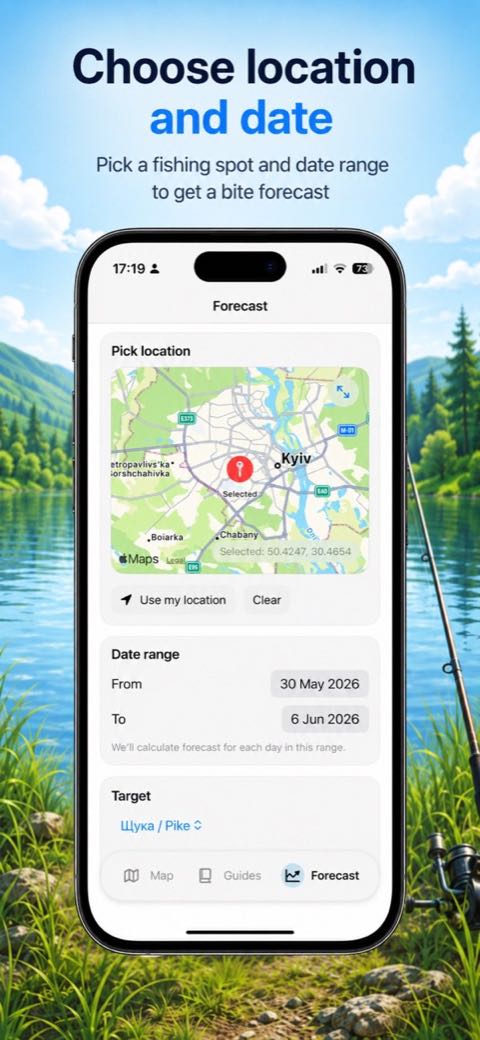
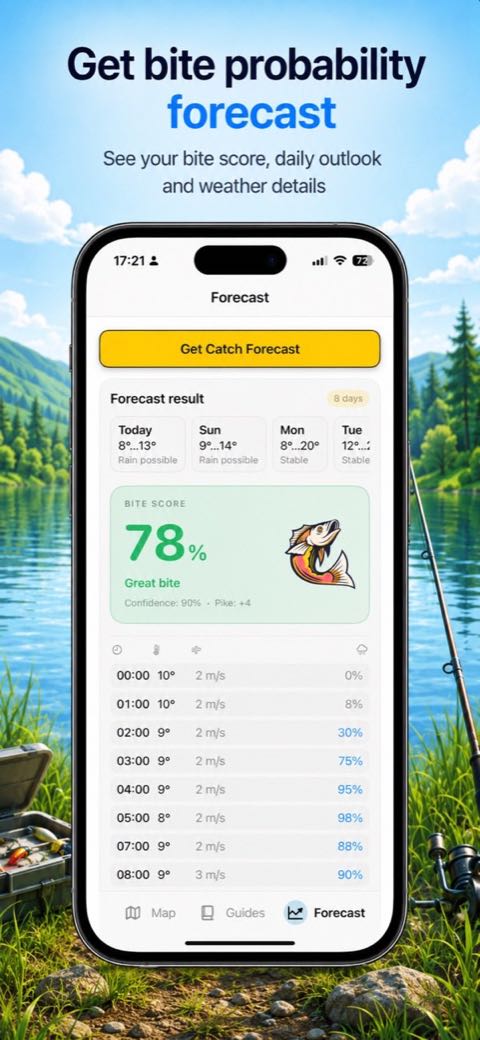
In the app you pick a point on the map, a date range and a species. GetCatch then shows a daily outlook, the bite score with a confidence value and the species adjustment, and an hourly list with temperature, wind and chance of rain. You can narrow the forecast to a time window, for example 05:00-09:00, and optionally choose the lure type you plan to use.
Stage 1: the weather score
The first stage turns the hourly weather forecast for your location into a score. Five factors are weighted:
| Factor | Weight | What scores best |
|---|---|---|
| Wind speed | 25% | A light to moderate breeze, peaking around 4 m/s. Flat calm and winds of 10 m/s or more score lowest. |
| Air pressure and trend | 25% | Pressure near 1015 hPa. A gentle fall of 1 to 4 hPa over three hours gets a small boost; a fast rise of 3 hPa or more gets a small penalty. |
| Air temperature | 20% | Around 16 °C, tapering towards 0 °C and 30 °C. |
| Chance of rain | 15% | A 10 to 30% chance of rain. Heavy, near-certain rain scores lowest. |
| Cloud cover | 15% | More cloud scores better up to about 60% cover, then slightly lower towards full overcast. |
Why these factors? They are the conditions anglers have long associated with feeding activity, and they are what a weather forecast can predict reliably a few days ahead. Pressure deserves a special note: the scientific evidence that fish respond to barometric pressure itself is limited. Pressure is most useful as a signal of changing weather, such as an approaching front that brings cloud, wind and a temperature change. We explain this in detail in barometric pressure and fishing.
Stage 2: species, season and time of day
Weather alone treats every fish the same. The second stage adds or subtracts points depending on the species, the season and the time of day, averaged across the hours you selected. A few examples from the current model:
- Pike gain the most at dawn in spring and autumn, and lose points around midday in summer. In winter the middle of the day scores best.
- Perch keep a steady morning and evening pattern through the year, with a midday lift in winter.
- Zander gain points at dusk, at night and before dawn, and lose points in bright midday hours, matching their preference for low light.
These adjustments are based on documented activity patterns of freshwater predators in Eastern Europe. If you choose a lure type, a small lure adjustment is added as well: for example, jigs and soft plastics add the most for zander, wobblers for pike. The model is designed to be refined with real catch data from the app over time.
Confidence: how far ahead to trust it
Each forecast also has a confidence value. It is highest for the next three days, then drops for each additional day ahead, and it falls further when weather fields are missing. A high score with low confidence means "promising, check again closer to the day".
How to use the forecast well
- Compare, don't obey. Use the score to choose between two evenings or two weekends, not to decide whether fish exist.
- Look at the hourly weather. If the score is held down mainly by rain, and you have good waterproofs, that may still be a fine day for pike.
- Narrow the time window. Entering dawn hours only gives a dawn-specific score instead of a whole-day average.
- Log your trips. Your own catch history in the catch journal is the best way to learn how your water responds to weather.
Check the bite forecast for your water
Pick a spot on the map, choose pike, perch or zander and get a bite score with an hourly outlook of temperature, wind and rain.

Free download. Requires iOS 17 or later.
Where the data comes from
Hourly weather forecasts come from Open-Meteo, which combines national weather models. GetCatch requests temperature, wind, precipitation probability, sea-level pressure and cloud cover for the exact point you choose. For a live example, see today's fishing forecast for Kyiv, which is recalculated every day with the same model.